NOTE: most of the photos here are my own, others were shamelessly borrowed from friends, or attributed to the owner when possible.
 |
| Welcome to Manila!! |
So, Liz, your “Recovered Third Culture Kid” fans are waiting
with bated breath to hear about your trip!
I’m sure your jet lag has passed by now; what the heck is taking you so
long?
I’m glad you asked! Yes, the dragon-like,
multi-horned and scaly, hideous beast that is jet lag has been permanently
exorcised from my brain.
I don’t
remember it being quite the soporific, coma-inducing incubus that it was before.
No amount of sleeping potions would make me
sleep at night; but oh boy would I sleep during the day! It finally, finally
left the night before I was to return to work.
A reparative, delicious slumber.
How to begin?
My dear
husband unfortunately had to stay behind due to illness.
I missed him so much, and longed to share my
feelings and reactions to being in the Philippines with him.
We were able to stay in touch due to modern
technology: a wonder of telecommunications called Viber.
 |
| Somewhere over the North Pole (or Russia) |
On the 3rd of January, I flew from Austin to
Detroit, Detroit to Seoul, and Seoul to Manila.
Let me tell ya, those Koreans have made life so much easier for
long-haul travelers. I don’t know about you, but there’s something about a
14-hour flight that makes you want to de-louse when you touch down. Is it the pressurized air that you
breathe? The exhalations of strangers
around you that cause the accumulation of that unnamed, insidious muck that
covers you when you arrive? What is
it? I had heard that there were showers
at Incheon Airport … and I was on a heat-seeking mission to find them. And I did!
Up in the transit lounge, you walk in, grab a towel and find an empty
shower room (hopefully the person in the occupied ones remembered to lock the
door!) and … glorious, cleansing, steaming water to wash away your travel
sludge. Every damn airport in the world should have them.
As we were landing in Manila, I was riveted to the window,
watching the night city sparkle nearer and nearer, and wowed to myself at the
lights floating on Manila Bay. By that time I was so tired, and ready to be
there, but the adrenaline was doing its thing, and I was giddy with anticip …
... ation.
My dear classmate Norbie had volunteered to do the airport
retrieval for lots of us; thank you so much for making my arrival so
painless!
The Manila Peninsula is still
there; it was where my parents and I stayed in 1978, when we flew back from
Singapore for my graduation from IS Manila. I saw the balcony above the lobby
where my boyfriend and I had said a sad goodbye.
(Truth: he was a blind date a friend had set
me up with for the senior prom.
We had a
very fast (less than a week!) and intense relationship!)
The next morning, I met up with the four Mulcahy sisters – I
had been friends with Mary, and when Mitch was unable to come, I asked if I
could be a Mulcahy for the week, and they happily “adopted” me!
Thank you sissies! We went on a walk to a small open-air market
with a group, led by our fearless leader, Rick Velayo, the Kissing Bandit.
You may ask .. WTH? I’ll tell you! Rick has
created this persona that has lasted through the years.
He told me once that long ago, someone was
taking a picture of him and a classmate, and as the count went down, three,
two, one, he suddenly shifted and kissed her on the cheek, making a photograph
that lives in infamy.
He gives you a
kiss on the cheek and you win a button!
The KB lives on.
I personally have accumulated two or three
buttons over the years at reunions.
It’s
all aboveboard, get your mind out of the gutter. We all love Rick.
And now he’s famous!
 |
| With the Kissing Bandit, and old friend Russell S. |
I can’t remember every single thing we did; my brain was in
a whirl.
I remember shopping at
Greenhills (north of Manila) and going a party at a friend’s house.
Another friend was happy to lend me his
driver (I know, I know, only a TCK would think that was normal!) to drive by my
old house on Cambridge Circle.
Not the
same house any more, sadly.
Like I said
before, a slight tropical breeze would have knocked it over back when we were
living there; no surprise it’s been replaced.
There was lots of sitting in the lobby meeting up with old
friends and new ones; chismis-ing (chatting in Tagalog) and just enjoying being
there. The conversations easily flowed like silk, smooth and comfortable. It was an eclectic mixup of all the hundreds
of people from Facebook that I had only known in pictures, and the ones I did
know, either from school or reunions. There were squeals and hugs and Oh my
god!s. The peninsula became chismis
central … a meeting place, a drinking place, a remember when place, all serenaded
by the tinkling of the keys from a piano on the mezzanine.
On Sunday there was merienda at the lovely home of our
guidance counselor, Vicky SyCip Herrera.
What can I say about Vicky?
She
has been the glue of our school; she taught us Composition and later became a
counselor. There was something about her that I’ve never seen in a guidance
office here in the states.
She and her
crew knew how to deal with us TCKs and all of our issues.
One friend I ran into told me the story of
how when he first moved to Manila, he was apathetic, depressed, and not eager
to go to school.
He would be dropped off
in the morning and then hightail it over to a little bistro near campus and
just sit and drink beer.
After a few
weeks of his truancy, the school (and his parents) caught on.
Rather than punishing him or expelling him,
Vicky and the headmaster said, okay, we’re going to help you.
We’re going to get you caught up with your
classes, and encourage you, and be there for you.
My friend felt that he mattered, that someone
cared about him and he responded to that.
He was able to start going to classes and excelled.
I could say that the US could learn something
from this, but that’s too big a hole to jump into.
 |
| The iconic Vicky Sycip Herrera |
 |
| I brought Vicky a copy of my book; after all I got my writing chops from her Freshman Composition class! |
Vicky has a room in her house that is covered, floor to
ceiling, with pictures of her past students.
We all had fun finding ourselves (some of us – me – were horrified!) and
reminiscing.
At the end of the
afternoon, I met up with Clenia Dimanche, the widow of the priest at our
Episcopal church in Makati. The church was a short walk from Vicky’s house, and
Clenia and I meandered over there, hand in hand.
She is one of the sweetest, most elegant
Filipina ladies that I know.
The story
is that her husband, Gaby, was a Belgian Jesuit priest (Catholic) sent to teach
in a school in the Philippines.
One his
students was young Clenia.
They fell in
love, and he left the church to become an Episcopalian priest.
They had three beautiful children,
and both had a long career as the leaders of Holy Trinity church in Forbes Park
(in addition to Gaby’s career on the Board of Directors at ISManila, and at the
Brent School.)
My parents and I were
faithful congregants of the church all the years we were there (okay, I was
somewhat reluctant – I was a teenager, for Pete’s sake).
I was the first female acolyte there, part of
the youth group, and taught Sunday school to the little kids.
For all the changes in Manila, Holy Trinity
remains the same, a tiny microcosm amidst the Big City.
My father had been a part of the committee
that built a columbarium behind the sanctuary, and I was proud to see his work
still standing after all this time.
After that visit down memory lane, I was driven by yet another friend's driver to the Urdaneta
apartments to join a party thrown by siblings who are the third generation of
their family to live in Manila. One of
the sisters still lives there and is a family physician; another sister had
been in my French class … their brother I had met when he visited Austin
once. They were so generous to host a
get-together for us; the pool-side area was chock-a-block with people dancing
and mingling with their barkada, new and old.
I fell, exhausted, into bed as soon as I got back to the
Peninsula; the next day marked the beginning of the official school
events.
Buses took us to the new campus
in Bonifacio Global City (or for the hip people in Manila, “BGC”) where we
wandered agog at the state-of-the-art building that resembled a highly endowed
university.
Seriously.
Tennis courts on the roof!
Two (or maybe three) swimming pools.
Robotics lab … little theater that could have
competed with Carnegie Hall.
We listened
to a lecture about the Battle of Corregidor, and ate lunch in the cafeteria,
which could pass as a millennial urban bistro. Former school sports stars reunited on the playing fields and basketball courts to see if they still had
their mojo.
 |
| Well loved by so many! |
That night was a cocktail reception in the ballroom of the
Peninsula. There had to be 600+ people
in there, and it was more chismis-ing and mingling. Surprisingly, every event meant meeting more
people that I had missed at the other functions. The vibe in the room was electric … so many
familiar faces, so many more hugs and cries of recognition and bear hugs. While
we “old folks” were there in masse, we could pick out the young ‘uns who
graduated more recently; they were just as ecstatic to be there as we were. After that (if you are tired just reading
about this, imagine how I felt!) we went to another hotel in Manila for a
karaoke party! Or should I say “Rockeoke”
party. Let me tell you, there are some extremely
talented people who went to my school!
It was not the “bad” singing that you usually encounter at karaoke;
there were some Broadway stars there! Any talent scouts there would have taken home
a treasure trove.
 |
| Just a few of our closest friends. |
 |
| Photobombing! |
Tuesday morning my body said, when presented with idea of
getting up, said Nope.
I listened to it,
and ordered room service, taking my time to reenergize and recharge my
batteries.
It had been a lot.
And there was more to come. My constitution
is a little less lively these days, and I was pushing it to the limit.
I ordered room service, “Filipino breakfast
please!” that included rice and eggs and beef and mango and calamansi juice (of
which I had a lot while I was there). It was divine. There’s just something
about eating garlic for breakfast that is quintessentially Filipino!
Love it.
 |
| Filipino breakfast! |
That afternoon was a bus tour of Makati and environs,
including BCG.
We found the place where
Our Old School had stood, now Century Mall, next to Trump Tower.
We did find the famous plaque which memorializes
the old IS Manila … but it was disorienting to find ourselves surrounded by
concrete monoliths.
No one could really
envision where the school had been.
Which way was up?
That part was
very sad for me.
I get that big cities
make progress, and progress involves replacing the past, and improving on
infrastructure.
The Manila I knew was
gone, with flashes of familiarity here and there.
Far fewer open spaces with lush green landscapes
and palm trees (though there are some!)
Heavy
sigh.
We drove to the American Cemetery,
which I remembered being not far from our house.
Having made the dive into genealogy recently,
I found that a cousin of my mom’s had been a pilot during the war.
He was flying wounded soldiers from somewhere
in Australia to somewhere else, and his plane was shot down.
There, among the names of soldiers,
Marines and sailors whose bodies were never found was the name of
William P. Ragsdale, Jr., along with 30,000 (yes, thousand) others, (Americans, and Filipinos) who were lost during World War II. There are too many names, carved on curving marble walls. The heroes whose bodies were found are buried
in immaculate concentric circles.
That
part of Manila is the same, and will never change.
We ended up again at the school … there was to be a huge
variety show in the Little Theater and we settled in for skits and music. Much
to many of our surprise, the Kissing Bandit performed the song
“Manila” by Hotdog, surrounded
by a crowd of dancing girls. We recognized the oldest alum attending the
reunion, who was from the 1940’s, and the lovely Ming Ramos, the wife of the
former President Fidel Ramos, who never quit her job at the school, and told us
that since the President’s wife didn’t get a salary, she had to work!
We heard about how President Quezon had helped 1100 Jews escape the
holocaust.
We saw how many of our classmates who dated in school actually married each other. We laughed, we cried. It was the show of shows.
From the theater, we were serenaded by a marching band as we made our way to
the “Barrio Fiesta” that was set up on the school grounds. Dancers in native garb lined the way to the
dinner, and a band played traditional music all the while.
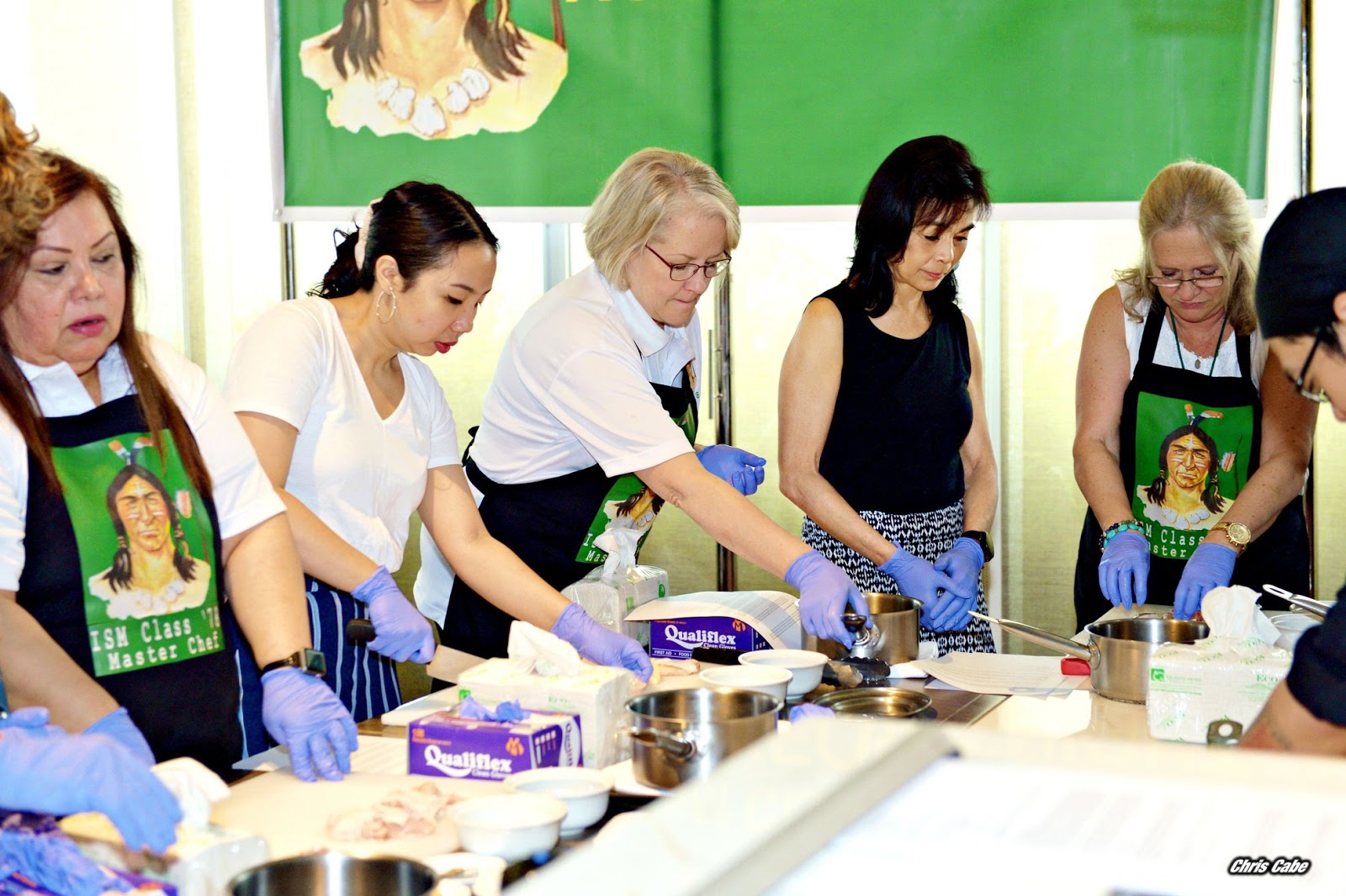
Wednesday began with a Filipino cooking class for our class,
1978.
Thanks to Jos Ortega, Grace Jong
and Bong Bernas (who did I leave out?) for putting this together.
We were kitted out in special shirts and
aprons, and learned to make Chicken Adobo, and Leche Flan.
Afterward the restaurant served up a 6-course meal!
Oof, the food just kept
coming and coming!
Lots of fun visiting
with our smaller group.
 |
| There's always room for dessert! (Chris Cabe Photo) |
 |
| Chris Cabe Photo |
 |
| Chris Cabe Photo |
Wednesday night was a big to-do at the Manila Polo
Club.
My parents hadn’t been members,
but I had plenty of friends whose families were, so I spent a great deal of
time there.
I remember sitting
in the middle of the polo field at night (we may or may not have been smoking
or drinking something), looking at the stars.
We had a school Sadie Hawkins party there.
Lots of my friends were seriously into
horseback riding, and that was where they spent many an afternoon after school.
There was a huge pool and a duck pin bowling alley. (Google it). Back in the day
I thought it was pretty chi-chi, and for sure it is even more so today.
The party was in the ballroom and extended
outside to the edge of the polo field, with the backdrop of BCG skyscrapers and
their cascade of lights. Unfortunately for me, all my binging on Filipino food
had caught up with me; the dress I brought specifically for this function would
not fit on my well-fed body.
I ended up
in a lesser and more casual version of the original … I’m sure everyone noticed
(not).
There was music, there were class
pictures, and just … being there.
And
so, the celebration was over.
The
official part, anyway.
 |
| Polo Fields with BGC |
Thursday, we drove in a caravan of minibuses 3 hours south
of Manila to Calatagan, where Vicky’s resort, Stilts, was waiting for us.
After seeing it in pictures, we could only
gasp at how much more beautiful it is in person.
We all shared cabanas (excuse me, floating cottages
over the water) so it was like a big pajama party. The next day, after lounging
around the pool, we joined up for a sunset cocktail party and then a dinner
under the stars that could have rivalled any wedding reception I had ever been
to.
Fire dancers, live music, buffet of
Filipino delicacies … it was outstanding in every way.
 |
| Tagaytay, overlooking Taal Volcano |
 |
| Like celebrities arriving at Stilits. |
 |
| A cheerful fellow, in spite of his job! |
The next day was a visit to a special ed
school that had been built with the generosity of the Mulcahy family (including my "sissies", their brothers John and Bill, and all of the Mulcahy grand and great-grandchildren) in memory
of their mom, who had volunteered in special ed school when they lived in
Manila.
Vicky’s late father’s foundation
also helped make the dream a reality.
There are so few special ed resources in the area, and this was a very
important contribution to the people of the area.
It was emotional for the sisters, and after
the official ribbon cutting and blessing of the building, we were regaled with
the children dancing and singing, and lots of speeches of gratitude. It was
moving beyond words.
 |
| The beautiful SpecialEd building |
 |
| The Mulcahy ladies: four "sissies" who kindly adopted me! |
Saturday included a barbecue at one of my classmates’ home
near Calatagan.
Ricky was the “it” guy
in our class, very suave and debonair.
He later became a professional polo player; now he is, among other
things, an artist and a politician … he carves wood into charming objets d’art
that festoon his house and grounds. There was lechon to eat, (turn away vegetarians!) and paella …
delicious in so many ways.
 |
| The view from Ricky's House, with Mindoro in the distance |
In the distance beyond Ricky’s hilltop house was the ocean and the
island of Mindoro, across the Verde Islands Passage, where my dad used to scuba
dive.
My family would drive to Batangas
and negotiate with a local banca owner to ferry us across the sea.
One time a storm was brewing, but we set out
anyway, only to turn around when the banca was nearly swamped by a rogue wave that nearly killed the sputtering engine. Maybe that’s why I have a phobia of
the ocean.
I thought I was going to get some rest at the beach … forget
that! There were more and more “meet me
at the pool” and snorkeling trips, and “join us for sunset watching” parties. Each
and every sunset was unique in its own way. I had forgotten how awe-inspiring
they were in the Philippines. There are
colors on the horizon surrounding the setting sun that I’ve never seen on the
spectrum.
Oh, and lest I forget to mention the volcano …
One evening, I appeared at the Mulcahy sisters’ cabin for a
“finish the liquor” party the night before we left.
Beth (one of my “sissies”) grabbed me and
pointed off into the distance.
“LOOK!
LOOK!” she said.
Now, I have a pretty long bucket list, but I
can state emphatically that seeing a volcano erupt is NOT and never has been on
that list.
I am a lover of nature and
its extremes, including tornadoes and hurricanes, but I never want to see one
of those extremes in person. That includes volcanoes. Everyone on the lanai was
watching it spew ash in an otherworldly display; almost like a nuclear mushroom
cloud.
As it got darker, the lightning
in the plume began to flash in earnest, and there were lots of oohs and aahs,
as if we were watching a fireworks display.
No one seemed very worried, and even though inside I was terrified, I
kept it to myself. I figured if they weren’t worried, why should I be?
Once I realized my personal safety wasn't at risk, the second thought I had was to remember the Icelandic
volcano back in 2010, where people in Europe were stranded for weeks after the
European airspace was closed.
I can’t
imagine a better place to be stranded than in the Philippines, but having just
started a new job, I was afraid that I wouldn’t have one if I was delayed
further.
My third thought was about all the people who lived around the volcano, and how their lives had most likely been affected by this. We had drive through dozens of tiny barrios and towns on the way to Stilts and I imagined that they were covered in ash and people were evacuating to points north. I thought about the beautiful Tagaytay, with its resorts overlooking the lake in which the volcano sat, with scenic views and manicured gardens ... what would be left of them?
 |
| Area of ashfall, with our location circled |
 |
| Not my picture ... |
Early that evening, we heard that we were going to leave
first thing in the morning to go back to Manila.
It seemed a little counterintuitive to me to
head towards the ashfall (which miraculously missed the tiny promontory on
which we sat) rather than away from it, but it was the way to get nearer to the
airport.
I had booked a room at the NAIA
Hilton (Ninoy Aquino International Airport) so I resolved that I would end up
there, stranded or not.
We drove right
past the volcano on the way back, which had calmed down a bit, but that was still
looking angry and volatile.
The roads
were covered in ash, and we all wore facemasks. The ash from a volcano can
contain tiny shards of glass from the molten lava: not a good thing for lungs.
We stopped at every Mercury Drug store to stock up on extra masks, but they
were all sold out. “Walang Facemasks” became the theme of our journey, “out ob
stock”. The airport was shut down for the immediate future, “until further
notice” so there were a lot of unknowns ahead.
 |
| The volcano as we drove by on the way back to Manila |
 |
| Cavite Police on duty |
 |
| Ash covers Manila |
We made it without incident and checked into the
oh-so-opulent Hilton. The pool and patio
were closed due to the ashfall, but I didn’t care about anything other than
taking a nap and checking the Delta app to make sure my flight was going to
leave the next morning. We all met up
once again for dinner (I groggily tore myself out of bed one more time) and
said our goodbyes.
Miracle of miracles, the runways were cleared of ash
overnight, and the airport was open.
The
volcano had settled down to a dull roar, and everything looked good for an on-time
departure.
I didn’t have much trouble
checking in (and clearing out the souvenir shop near my gate) and we even took
off a little earlier for Narita.
Quick
stop in Japan, and it was off to Detroit, then home to sleep for a week (see above).
 |
| Are we there yet? (and yes I busted out the sheckels for an upgrade - cheaper when bought last-minute!) |
As it is oh-too-common with these grand events that are
planned and anticipated for a long time, it was all over too quickly, and
coming down from the high was difficult.
Looking back, I realized that there were times during the celebrations when
I felt a little of the high school ennui creep back into my consciousness.
Occasionally I found myself alone, separated from
the ones I knew, with that same fear of “damn, who will I sit with” only to
hook back up with the friends shortly thereafter.
I found out that some people had done things
that I would have liked to have done and had missed the boat, because there
simply wasn’t time to do everything. I felt anxious, and the clock was running
out too quickly.
I realized that I would
probably not return to the Philippines any time in the near future, if ever. I
guess the sense of closure, while emotionally healthy, was on some level sad
beyond measure.
I like the word “ennui”
because it’s really not something you can put a finger on, other than calling
it “cognitive dissonance”.
It’s unexplainable.
It’s “saudade”, the untranslatable Portuguese word that I have tattooed on my arm, a feeling of
longing, melancholy or nostalgia; a feeling that has no cure.
There is no place to go to satisfy or lessen
those feelings.
There is no “home”. Going
back to a place is not the solution; we can’t escape carrying our longings with
us.
And most of the time we don’t know
what we are longing for. Our house was gone, the Intercontinental Hotel, where
most of us stayed before our furniture arrived, was gone, the school was gone, our
TCK infrastructure was just .. gone.
 |
| The "Intercon" as we knew it |
Oy vey, drowning in my existential ennui (there it is
again!) here. For us, “home” is not a physical place. But then I think about non-TCKs, and how they
grieve when their childhood home is sold. That place may have been solid ground
for them, but the “home” that they are grieving is what happened in that place,
and the people who lived in it, not the building itself. (My mom gets furious when realtors talk about
‘new homes’ because they aren’t homes, they are houses!) “Home” for me was and is the corporate body
of people who attended the Centennial Celebration at IS Manila with me. That whole group of 1000+ people, all the way
from the 1940s students to the 2000s, they were home.
During the “variety show” the head of the Board of Directors
of the school spoke about how we, when we return to Manila, slip into speaking
in a Filipino accent. In some cases that
could be seen as disrespectful or racist, but for us, it is a loving tribute to
the Philippines and its people and reminds us of how we bloomed and grew in
that place. We love and honor our common
history and the third culture that we formed when we lived there.